


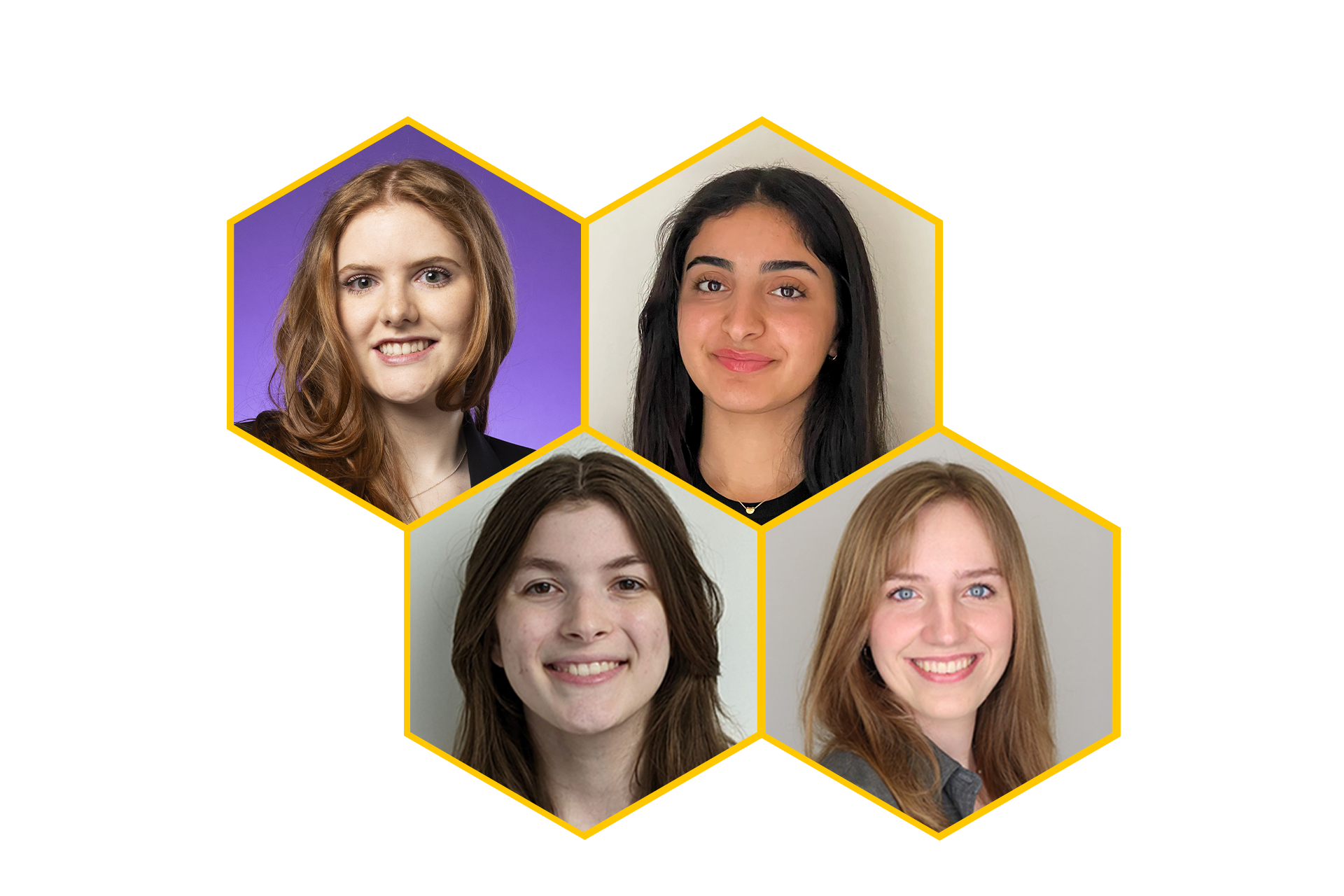
Lauren Ellis, Kiana Gholamy, Andrea Guiley, Maxine Lovelace receive grants to perform novel clean energy research at the UW’s open-access labs for climate tech innovation
April 8, 2026
The Washington Clean Energy Testbeds, an open-access climate technology lab operated by the University of Washington (UW) Clean Energy Institute (CEI), has granted four UW students Undergraduate Research Awards.
Established in 2023 thanks to a generous philanthropic gift to CEI’s Innovation Fund, the Testbeds Undergraduate Research Award provides UW students with $3,000 over three academic quarters to perform novel research at the Testbeds. All UW undergraduate students in their third academic year or higher are eligible to apply for support for research in clean energy, advanced manufacturing, and related fields.
“We’re delighted to continue to support opportunities for undergraduate research at the Testbeds,” said Testbeds Managing Director Dr. Michael B. Pomfret. “Hands-on experience working in an innovation lab like ours can be formative for young engineers and scientists. From creating next-gen battery anodes and conductive films to enabling second lives for plastic and tires, these projects demonstrate how UW students innovate to tackle global challenges.”
“Thanks to these awards and the support from my mentors and the Testbeds team, I’ve learned how to design my own projects and present my work professionally,” said Andrea Guiley, a UW senior majoring in chemical engineering, who won her second Testbeds award this year. “I’m passionate about clean energy research and this experience was great to highlight while applying to Ph.D. programs.”
The projects supported by 2026 Testbeds Undergraduate Research Awards are:
Magnetic nanoparticle catalysts for plastic recycling

This project aims to inform the scale-up of electrified, low-emission facilities for plastic recycling and biofuel production. Ellis will use several different characterization tools available at the Testbeds to establish real-time, non-destructive diagnostics for nanoparticle catalysts used to recycle waste plastic into fuels and other value-added products. Nanoparticle catalysts containing cobalt, nickel, and iron oxides are particularly promising because they can be recovered using magnetic separation—a fully electrifiable, low-energy alternative to filters or centrifuges—but the moisture and impurities in real-life plastic waste streams create a residue that effectively clog up these catalysts, reducing their performance and recoverability.
Upcycling waste tire rubber into tire char media for water treatment

A common method of recycling tires is to grind them into crumb rubber, which is commonly used in athletic turf field infills and in playground rubber mats. Crumb rubber contains chemical contaminants, including 6PPD-quinone, that can leach into the environment and cause significant harm to aquatic organisms and ecosystems.
The goal of this project is to upcycle crumb rubber into an activated carbon media that can adsorb these leached chemicals. Converting crumb rubber into a “tire char” would enable the cleanup of a major pollutant with its own source material—a step towards a circular economy for tire rubber.
Gholamy will generate tire char in a tube furnace at temperatures of 500–800°C, then use the Testbeds’ scanning electron microscope to image the raw crumb rubber as well as the activated carbon; and the Brunauer-Emmett-Teller analysis to characterize specific surface areas and pore sizes, which are key to absorption. This will help identify how waste tire rubber char can be recycled and implemented in water treatment settings to remove tire-derived contaminants.
Prototyping high-power batteries with antimony sulfide nanoparticles

Graphite is the most commonly used negative electrode in modern lithium-ion batteries, but its layered structure only allows lithium ions to travel 2-dimensionally, limiting battery charge/discharge rates. Introducing antimony sulfide nanoparticles to graphite electrodes creates 3-dimensional channels that improve ion transport in the battery while also increasing coulombic efficiency and capacity retention. The integration of these nanoparticles boost battery performance and may consequently allow for the use of lower-quality, but more ecologically friendly, graphite materials in future battery production.
This project involves synthesizing antimony sulfide nanoparticles with the Pozzo group’s emerging low-cost, low-energy technique and assembling and testing prototype batteries. Guiley is mentored by Pozzo group and UW CoMotion postdoctoral researcher Dr. Kevin Lee, a CEI Graduate Fellow with a Ph.D. in chemical engineering from the UW, who co-founded a startup called Janutech to commercialize antimony sulfide nanoparticles for high-power batteries. The high-power battery prototyping project is Guiley’s second Testbeds Undergraduate Research Award.
Algae-based conductive films for batteries, fuel cells, and flexible electronics

This project focuses on developing conductive film materials using biochar made from abundant algae species, Chlorella and Spirulina, as feedstocks for the polymer filler. Conductive polymer films are commonly used as current collectors in batteries, electrodes in fuel cells, and functional layers in flexible electronics. These traditional films containing plastics like polyethylene filled with nickel or carbon are not easily degradable and present a significant environmental risk due to their high concentration of heavy metals.
Lovelace will use the Testbeds’ SEM, x-ray diffractometer, and potentiostat for characterization. If the mineral content of the algae biochars is found to inhibit conductive film performance, she will pursue an alternative path for biochar production using various catalysts while heating in the tube furnace to increase conductive potential.
Learn more about the Testbeds Undergraduate Research Award here.

